Published in *82 Review, 2019
Sitting drinking beer in Chen Da Jie’s garden, we notice motes of bamboo sawdust drifting down on us from the roof. “Those bumblebees, they’re li hai,” she complains. In rural China, li hai is normally a term of approval. When you complete a long-distance hike at altitude, or a bruising cross-province drive, or swim across a river just free of its spring skim of ice, you’re li hai. As we watch Chen Da Jie batting the eaves with a broom, it is clear that in this case li hai is firmly negative.
Bumblebees, with their erratic hive habits and preference for hunkering in their hundreds in abandoned rodent tunnels, are considered a nuisance. Chen Da Jie tells us about her neighbor who had been hoeing his field the previous year and unwittingly disturbed a ground hive. He was taken to the local hospital in Lin’an but died from the stings. Being li hai, one bumblebee can sting many times. “They even steal nectar,” she grouses, alluding to their anti-social habit of biting a hole in a blossom, and shirking their duties as pollinators.
Honeybees, though, are treasured. While the news from Europe and America is of colony collapse, here on the mountain, apiculture is a thriving part of the local economy. Every farmstead has at least a couple of hives, and some neighbors combine their summer guest house business with honey farming. During a good summer, jars glowing molasses-black to chamomile-gold are ranged for sale on upturned crates by the roadsides.
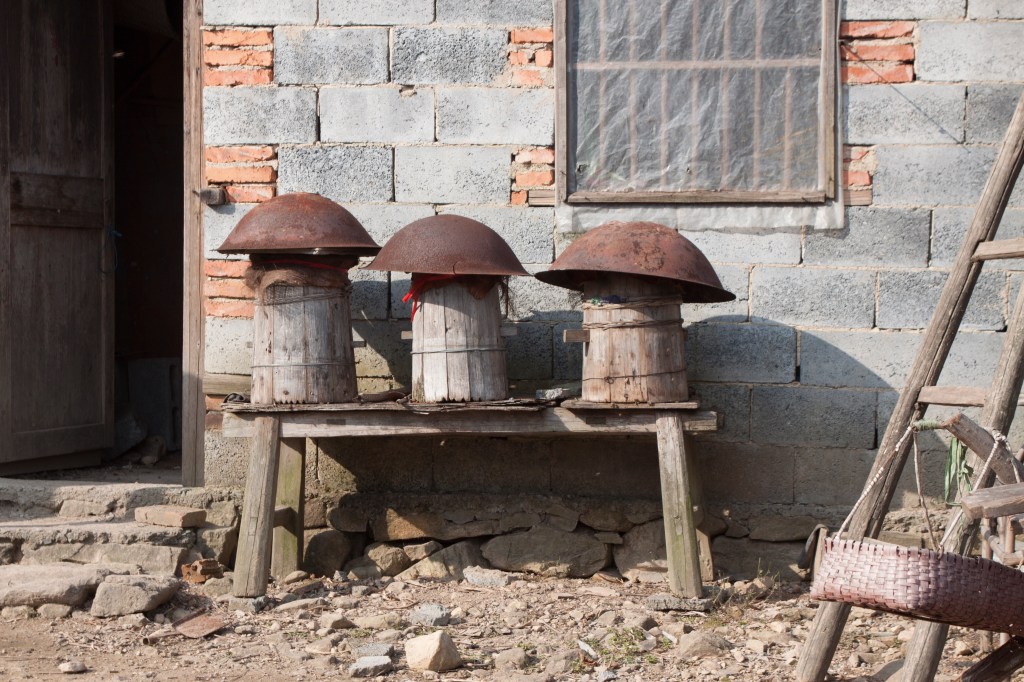
The local style of beehive is a round wooden bucket capped by what looks like an upturned iron wok. When we first moved to this mountain, we mistook them for cooking vessels, and wondered what delicacies were quietly steaming inside. In the larger villages down in the valley, honey is farmed commercially, and sometimes we see the more familiar square crate hives stacked in courtyards. Those bees are fed sugar-water, and their honey is blandly sweet.
Read More at *82 Review

 Fiona Lindsay Shen